


PPC vs SEO: Which Digital Marketing Strategy Is Better for Your Business?
Every business owner is faced with the same question at some point in growing online: do you spend the budget on paid ads or organic search? If you are a company looking at SEO services Pitampura or PPC services Pitampura, the answer is rarely a simple either/or. Both are for people who are actively looking but they work differently and they cost differently and they pay off on different time lines.
Here’s a breakdown of how each works, so you can match the channel to your goals, budget, and market.
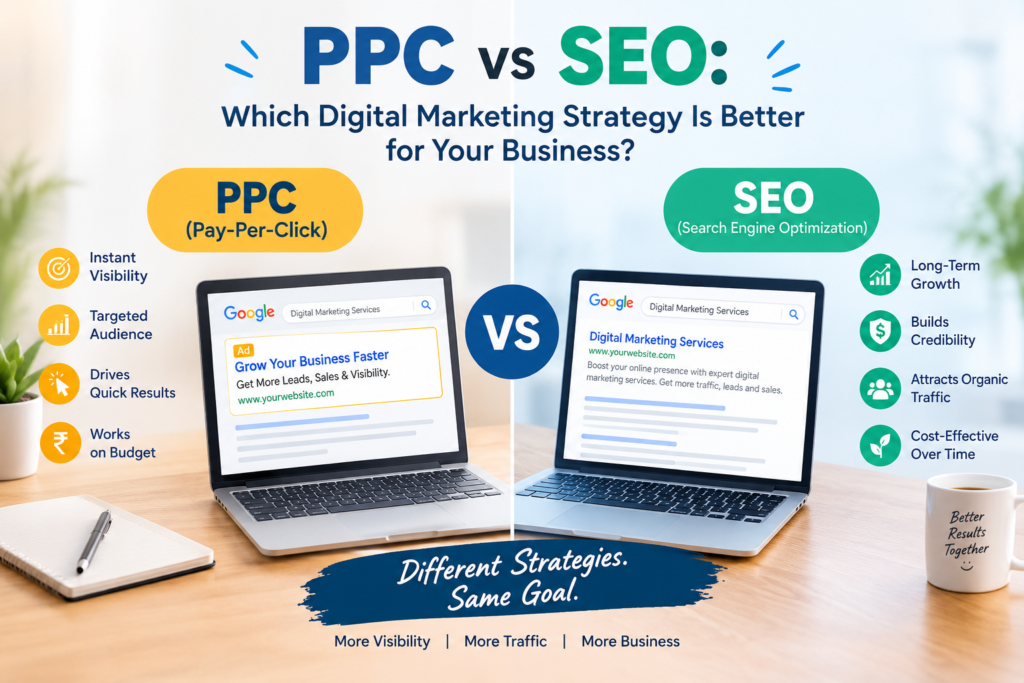
What is PPC & SEO?
What Are PPC (Pay Per Click) Ads?
PPC (pay-per-click) is a paid search marketing strategy. You bid on keywords, and your ad can appear at the top of search results when someone searches for those keywords. You only pay when a user clicks. Not when the ad is shown. Google Ads is the most common of the platforms.
SEO meaning What is SEO?
SEO, or search engine optimization, is organic search marketing. It improves a website’s content, structure, technical health and relevance so that it will show up in the free search results. There’s no pay per click, rather you pay for content, technical work and ongoing improvement.
Lorem ipsum dolor sit amet, consectetur adipiscing elit. Ut elit tellus, luctus nec ullamcorper mattis, pulvinar dapibus leo.
The main difference Paid vs organic visibility
Paid visibility is rented. Your ads will run as your campaign runs, as your budget permits. Stop the traffic, end the campaign.
Organic visibility takes work. It takes time to grow rankings because Search engines want to see that your pages are relevant and useful. Once a page is set up it can still attract visitors without a per click charge. But they have to keep up the rankings.
Most searchers treat them differently.” Some will click on an ad without a second thought, others will bypass it and scroll to organic listings. Being present in both places can generate brand awareness.
Speed: Long Term Growth vs Instant Traffic
A well structured PPC campaign will start to get you traffic almost straight away once it’s approved and launched. Which makes it ideal for a new business, seasonal promotion or product launch.
SEO is a long game. Timelines depend on competition, site health and content quality and real results happen in months, not days. A local niche search will take less time than a competitive keyword in Delhi.
The trade off is simple: PPC is fast, SEO is durable.
How Does PPC Pricing Function
In PPC, spend, clicks, conversions and customer acquisition are inherently connected:
- Ad spend is the amount of money you spend on a campaign.
- Cost per click (CPC) is the amount paid for each click, which is affected by keyword competition, ad quality, and bidding.
- Conversion rate is the percentage of visitors who take the desired action – be it a call, a form submission or a purchase.
- CPA ( Cost Per Acquisition ) is the cost to acquire one customer / lead.
If a clinic spends Rs 20,000 and gets 400 clicks, the average CPC will be Rs 50. If out of those visitors 20 book appointments then the cost per appointment is ₹1,000. It’s all about what a patient is worth to the business, whether that works or not.
PPC gives good control on budget. You are able to set daily limits, change your bids and pause campaigns that are not performing well. Costs are on-going and competition can drive CPC higher.
The Long Term Visibility of SEO
Costs of SEO are more indirect. You’re paying for content, for tech upgrades and ongoing optimization, not for each visit. Lots of related searches can begin to show good pages regularly, over time.
SEO most often involves:
- Publishing content that solves real customer problems in a people-first way
- Increase site speed, mobile friendliness and structure
- Content for service & product pages
- Add trust signals such as accurate business information and reviews
The only problem is that it’s predictable. The results are less predictable than a paid campaign, and rankings can change with competitive and search engine updates.
The Role of Keyword Targeting in Both Strategies
Keywords are the bridge between what people are typing and what you have to offer. But each channel uses keywords differently.
In PPC you select keywords and match types, then bid on them. You’re in the driver’s seat for the searches your ad will appear in. You can use negative keywords to stop your ad from showing for irrelevant searches.
That means rankings . In SEO you create pages around topics and search intent . You don’t get to control what searches your pages come up for, but you do get to control the
In both counts of purpose. Someone searching for “buy running shoes online” is closer to purchase than someone searching for “how to choose running shoes.” PPC often performs well for transactional terms, and SEO content does well for informational searches that build awareness and trust. The two can work hand in hand, PPC data shows you which keywords are converting and then SEO can build content around it.
PPC Advertising Agency, Pitampura Local
Geographic precision benefits local business promotion. You can reach with Google Ads:
Some areas like Pitampura, Rohini or Shalimar Bagh
A radius around your clinic, office or shop
specific time of day/day of week mobile users’ ‘near me’ search
A coaching center, for instance, may advertize only in the nearby neighborhoods during the admission season. A restaurant may be open in the evening. That way you don’t spend on audiences you can’t serve. This is useful for service led and appointment led models and businesses looking for PPC services in Pitampura often find this.
Agencies operating with both paid and organic channels, like Le Insight Studio (LEINSIGHT), typically begin with market and objective analysis before proposing a campaign structure. Businesses comparing PPC services Pitampura options can also look for that type of planning that is aimed at goals first.
Local SEO gives businesses a chance to rank in local results.
Local SEO services optimize rankings for searches with local intent (map results, searches for “near me,” etc.). Main consituents are:
- Complete Google Business Profile with Accurate Address, Hours, Categories and Photos
- Trusted business information anywhere in all directories and platforms
- Content on the website that is relevant to that location (i.e. service pages that list the areas you serve)
- Customer input and well thought out response to feedback
- Fast loading times and mobile optimized pages.
If you have a local business, being on the map when someone searches for “dentist in Pitampura” could mean calls and foot traffic. If you’re a business in Pitampura and you’re looking for SEO services, this is usually where you start. Building local relevance is easier than building national visibility.
PPC vs SEO – Side-by-Side Comparison
Pace (foot)
PPC- Can quickly drive traffic after launch.
SEO: It grows slowly, sometimes over months.
Control of finance
PPC: Extremely High You can easily change daily limits and bids, but you pay for traffic for as long as you desire.
SEO: Lower costs per click, but results are less predictable and less directly controllable.
Visibility
PPC: Shows up in paid placements for selected keywords and areas when the campaigns are active.
SEO: It can appear on organic and local listings and remain there without paying per click.
Purpose of the Traffic:
PPC: Great for high-intent, conversion focused keywords.
SEO: Covers a range of intent, from research to purchase.
Long term gameplan
PPC: Spend is ongoing, pushes traffic.
SEO: Can grow over time as content and authority increases.
Measuring
PPC: Transparent Click, Cost & Conversion Data.
SEO: It’s measurable, but harder to attribute.
No column wins on all the rows. Each is better for certain circumstances.
When to Use Both PPC and SEO
You could be right for PPC if:
- You need fast visibility for launching a new business or product
- You have a limited-time offer or seasonal campaign
- You want to test which messages and keywords convert
- Your website is new and doesn’t have much organic visibility yet
- You want tight control over budget and location
Thinking about SEO? It could be right for you if:
- Dollar cost averaging over the long term
- Your customers do their homework before they buy.
- You want discoverability that is sustainable, not ad spend depende
When you might be a candidate for a combo:
- You want early PPC results while organic visibility is building
- You want to pull all the important queries for paid and organic listings
- You need PPC conversion data to drive content, SEO priorities.
Imagine an ecommerce store in Delhi. It might do PPC for a holiday sale, but build category pages and guides through SEO for all year traffic. A local plumber might use PPC for those instant “emergency plumber” searches, and local SEO for all-around neighborhood visibility.
Why to Set Business Goals and Track Conversions?
Traffic is not enough by itself. Define what success looks like before you choose a channel: calls, form fills, store visits, purchases, bookings etc.
Conversion tracking links marketing activity to results. Without it you don’t know which keywords, ads or pages are bringing in customers. Get tracking in place for phone calls, forms, purchases, and key button clicks before you spend big.
Your business model also dictates your choice. A business like consulting, which is a high value, low volume offering, can afford to spend more per lead. It needs lower acquisition costs with low margin product. The economics have to work for the channel.
Analysis of PPC and SEO Performance
- Key PPC Metrics
- Click-Through Rate (C.T.R.
- Cost per acquisition (CPA)
- Conversion rates
- Cost of acquisition (COA)
- Return on advertising investment (ROAS)
- Impression Share
- SEO important metrics
- Organic traffic Keyword ranking and visibility
- Visibility in maps and local packs
- Organic Conversions & Leads
- Engagement metrics like time on page and bounce rate
- Growth in branded search
Watch PPC data regularly – you can tweak campaigns quickly. When thinking in terms of SEO longer term, trends are more relevant than day to day changes. Either way, don’t just look at clicks, relate metrics to revenue or quality of leads.
Conclusion
The Right Way for Your Business
PPC and SEO are not enemies, just different tools. PPC gives you speed, targeting and measurable acquisition costs. But traffic costs money. SEO is a slow-burn strategy that builds long-term visibility and credibility, but is less predictable in the short term.
The right choice depends on your goals, budget, timing, competition and customer acquisition model. A business with a launch date might need paid visibility to start. For a service provider with a stable budget and patience, organic presence can be a good option. For many Pitampura and Delhi-wide businesses, the most successful approach is to combine paid search to capture immediate demand, and organic search to grow.
FAQ (Frequently Asked Questions)
Q1. PPC vs SEO – What’s the Difference?
PPC is pay per click and is paid advertising. SEO gives you free visibility through relevance and optimization. PPC can get you started quicker, but SEO tends to grow slower.
Q2. For a small business in Pitampura, is PPC or SEO better?
It really depends on the goals, budget and time line. If you need quick inquiries, focus on PPC and if you want visibility in the long term, focus on SEO. Many use a combination of both.
Q3. How quickly do PPC campaigns drive traffic?
Once approved, your ad is live and can start to get clicks immediately. Performance generally improves as the campaign ages.
Q4. How long does SEO usually take?
Depends on competition, quality of site, consistency. “Progress is measured in months, not days, for most businesses.”
Q5. How Can I Know the Budget For PPC Services in Pitampura?
First, figure out what a customer is worth to you and what you can afford to pay for one. Then test with a budget you can manage and consider keyword competition before you expand.
Q6. Local SEO Services Only Help Google Maps Rankings?
No. Local SEO is also helpful to organic listings with location relevant content, consistency of business information, reviews and site quality.
Q7. Can You Run PPC And SEO At The Same Time?
Yes. Running both can get you early traffic and long term growth and the data from each can improve the other.